

TL;DR:
- Chewing gum activates brain circuits that increase attention-related theta waves, boosting focus.
- Its cognitive benefits are most reliable during sustained attention tasks and when used consistently.
- Sugar-free gum with xylitol supports both mental arousal and dental health simultaneously.
Chewing gum is not just a habit or a breath freshener. It is a surprisingly effective way to prime your brain for sharper attention, faster reactions, and more resilient focus. Research shows that chewing boosts frontocentral theta power, a brainwave pattern directly linked to better attention and working memory. This happens through a specific neural circuit connecting your jaw movement to your brain’s alertness centers. In this article, we break down exactly how that process works, what the research really shows about the limits and benefits, and how to use chewing strategically to get a genuine mental edge.
Table of Contents
- How chewing affects the brain: The science of arousal
- What the research says: Benefits and limitations of cognitive arousal by chewing
- Factors that influence the effects: When and how chewing boosts cognition
- Beyond focus: Dental health and functional foods for cognitive support
- Our perspective: The realistic role of chewing for mental performance
- Experience the benefits: Try functional gum for brain and dental health
- Frequently asked questions
Key Takeaways
| Point | Details |
|---|---|
| Chewing boosts brain activity | Chewing gum can measurably increase brainwave activity linked to better focus and memory. |
| Benefits depend on context | Cognitive gains are strongest during sustained attention and may vary based on gum type and individual factors. |
| Sugar-free gum supports health | Choosing xylitol-based, sugar-free gum enhances both cognitive performance and dental health. |
| Functional gum fits modern wellness | Using functional chewing gum aligns with holistic approaches to support mental clarity and oral care. |
How chewing affects the brain: The science of arousal
When you chew, your brain does not just passively register the movement. It responds with a cascade of neurological activity that measurably shifts your mental state toward greater alertness. Understanding this process helps you use it intentionally rather than stumbling into it by accident.
The key circuit involved is the Locus Coeruleus-Thalamic-Cortical loop. The Locus Coeruleus is a small but powerful cluster of neurons in the brainstem that acts like a master switch for arousal. When activated, it releases norepinephrine throughout the brain, which increases neural excitability and sharpens attention. Chewing triggers this circuit through the trigeminal nerve, which runs directly from your jaw muscles to your brainstem. The signal travels upward, activating the thalamus and then the cortex, particularly the prefrontal cortex where decision-making and focus live.
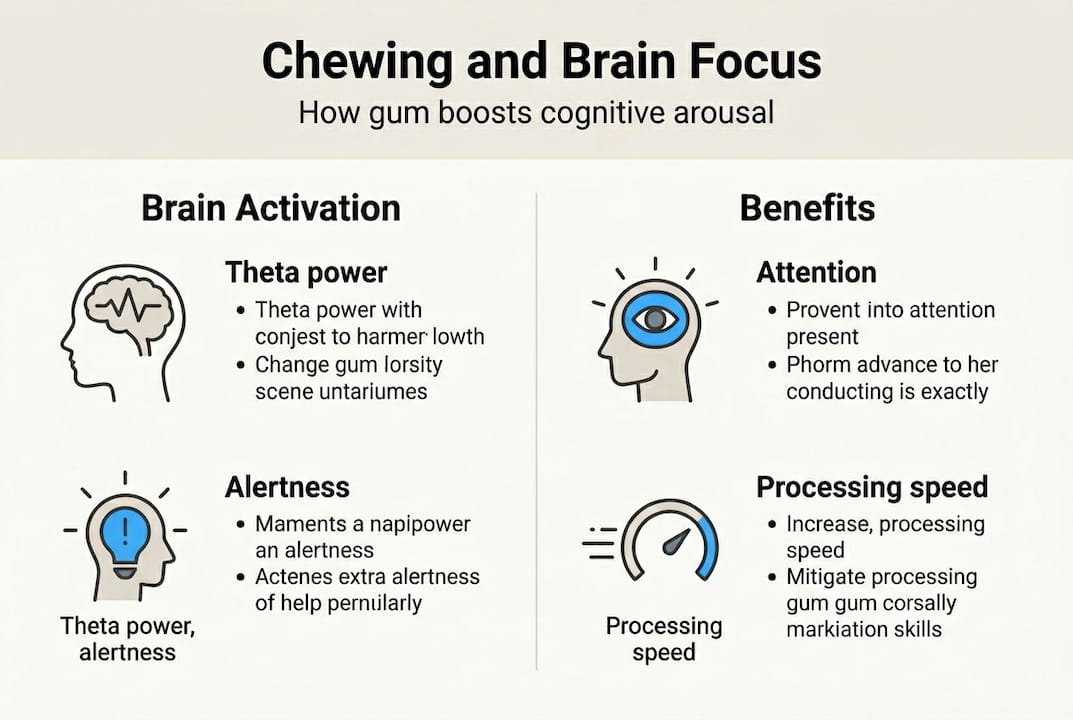
The result is measurable. Chewing increases theta power in frontocentral brain regions, which correlates with improved performance on attention and working memory tasks. Theta waves (4 to 8 Hz) are associated with focused mental effort, and when their power increases, your brain is essentially running in a higher-performance mode for cognitive tasks.
For a clearer picture, here is how the brain responds during chewing compared to rest:
| Brain region | Response during chewing | Cognitive effect |
|---|---|---|
| Prefrontal cortex | Increased blood flow and activation | Better decision-making and focus |
| Hippocampus | Elevated oxygenation | Stronger memory encoding |
| Reticular activating system | Stimulated via trigeminal nerve | Higher alertness and wakefulness |
| Frontocentral cortex | Increased theta power | Improved attention and working memory |
To learn more about why this matters for functional formulations, the science behind functional gum goes deeper into how ingredient delivery and mastication work together.
“Chewing gum activates the Locus Coeruleus-Thalamic-Cortical loop, producing measurable increases in frontocentral theta coherence and directly improving performance on sustained attention and working memory tasks.”
This is not a subtle or theoretical effect. It is a real, measurable shift in how your brain operates, triggered by something as simple as rhythmic jaw movement.
What the research says: Benefits and limitations of cognitive arousal by chewing
Understanding the brain mechanisms is only part of the story. What does the research really show about how chewing impacts your cognitive performance?
The evidence is genuinely promising but also more nuanced than most headlines suggest. A review of 26 studies found that chewing gum produced benefits across memory, attention, and executive function. However, the same review noted adverse effects on some tasks, difficulty replicating results across labs, and effects that were not always robust or consistent across individuals.
Here is a direct comparison of what the research supports versus what it does not:
| Cognitive domain | Evidence for benefit | Evidence for limitation |
|---|---|---|
| Sustained attention | Strong, consistent across studies | Less effective for short bursts |
| Working memory | Moderate, task-dependent | Not universal across populations |
| Reaction time | Improved in later task stages | Minimal effect early in tasks |
| Executive function | Positive trends | Inconsistent replication |
| Complex reasoning | Weak or mixed | May even impair some tasks |
The top benefits of chewing gum are most reliable when the task demands sustained vigilance rather than complex, multi-step reasoning. Think long study sessions or shift work, not creative brainstorming.
Factors that appear to influence whether you get a benefit include:
- Task type: Sustained attention and vigilance tasks show the strongest effects.
- Timing: Chewing during a task tends to outperform chewing before it.
- Individual differences: Baseline arousal level, oral health, and stress state all matter.
- Gum type: Sugar-free formulas with active ingredients appear to outperform plain gum.
- Chewing intensity: Harder, more rhythmic chewing activates the trigeminal circuit more strongly.
The honest takeaway is that chewing gum is a real cognitive tool, but it is not a dramatic one. It works best as a consistent, low-effort support rather than a high-powered intervention.
Factors that influence the effects: When and how chewing boosts cognition
So when does chewing help you think clearer, and when does it not make much difference? Here is how to get it right.
The research makes it clear that effects are task-specific, stronger for sustained attention and vigilance, and shaped by chewing intensity, flavor, timing, and individual factors including oral health. That means your results depend heavily on how and when you chew, not just whether you chew.
Here is a practical, step-by-step approach for getting the most out of it:
- Start chewing at the beginning of your focus block. Chewing during a task activates the arousal circuit while you need it most. Chewing before and then stopping may reduce the effect.
- Chew for at least 10 to 15 minutes. Short bursts do not give the trigeminal-cortical loop enough time to build sustained theta activity.
- Choose sugar-free gum with xylitol. You get the cognitive arousal benefit without the oral acid load that sugar creates.
- Use it for sustained-focus tasks. Long study sessions, extended meetings, shift work, and driving are the best use cases.
- Observe your own response. Track whether you feel more alert and less distracted after two to three sessions. Individual variation is real.
Pro Tip: Sugar-free gum with xylitol gives you a double benefit: the mastication-driven arousal effect for your brain and active remineralization support for your enamel. It is one of the few habits that genuinely multitasks.
One important caveat: if you have jaw tension, TMJ issues, or certain dental conditions, intense or prolonged chewing may not be comfortable or appropriate. Research also shows that in mandibular prognathism, reduced chewing-induced brain blood flow correlates with poorer cognitive performance, suggesting that jaw mechanics directly influence how much cognitive benefit you get from chewing. If chewing causes discomfort, the arousal signal may be blunted anyway.
For a more detailed breakdown of how to optimize gum chewing for both mental and dental outcomes, there is a full guide worth reading alongside this one.
Beyond focus: Dental health and functional foods for cognitive support
With dental and cognitive health more connected than you might think, here is how functional chewing gum can deliver on both fronts.
The cognitive benefits of chewing do not exist in isolation. Your oral environment directly affects your comfort, your confidence, and even your ability to focus without distraction. A mouth that is healthy, well-mineralized, and free from discomfort is a better platform for sustained mental performance.

Sugar-free chewing gum supports dental health by reducing caries through xylitol, stimulating salivary flow, and helping neutralize the acid attacks that erode enamel over time. These are not minor perks. They are the foundation of a healthy oral environment that supports everything from eating to speaking to concentrating without tooth sensitivity pulling your attention away.
Here are the key dental benefits of sugar-free, xylitol-based gum:
- Xylitol reduces harmful bacteria in the mouth by starving the strains that produce enamel-eroding acid.
- Increased salivary flow raises oral pH, shifting the environment away from demineralization and toward enamel repair.
- Calcium and phosphate redeposition is encouraged when salivary flow is strong and pH is stable.
- Reduced dry mouth lowers the risk of cavity formation and gum sensitivity.
- Fresher breath without the sugar spike that feeds acid-producing bacteria.
The functional food movement is growing precisely because people want products that do more than one thing. Gum that supports both mental clarity and dental health fits that demand perfectly. It is not a supplement you have to remember to take. It is a habit that layers benefits without adding complexity to your day.
Pro Tip: Look specifically for xylitol on the ingredient label, not just “sugar-free.” Some sugar-free gums use sorbitol or other polyols that do not carry the same anti-caries benefit. Xylitol is the active ingredient that makes the dental and brain health benefits stack together effectively.
Our perspective: The realistic role of chewing for mental performance
Here is our honest take, shaped by both the research and real-world use patterns we observe: chewing gum is not a biohack. It is a biological lever. That distinction matters.
The biohack framing sets up unrealistic expectations. People try it once during a tough afternoon, feel mildly more alert, and then either dismiss it as placebo or expect it to replace sleep and hydration. Neither response is useful.
What the evidence actually supports is this: consistent, well-timed chewing during sustained-focus tasks can meaningfully reduce vigilance errors and extend productive attention spans. That is a real, practical benefit. It just does not look dramatic in the moment.
The most effective users we see are not chasing peak performance moments. They are using practical uses for chewing gum as one small, consistent layer in a broader system that includes hydration, movement, and intentional rest. Gum alone moves the needle modestly. Gum combined with those other inputs moves it noticeably.
The contrarian truth is that the boring, repeatable habits are almost always more effective than the dramatic interventions. Chewing sugar-free functional gum every day during your focus blocks is exactly that kind of habit.
Experience the benefits: Try functional gum for brain and dental health
Ready to put the science to work and experience cognitive arousal for yourself?
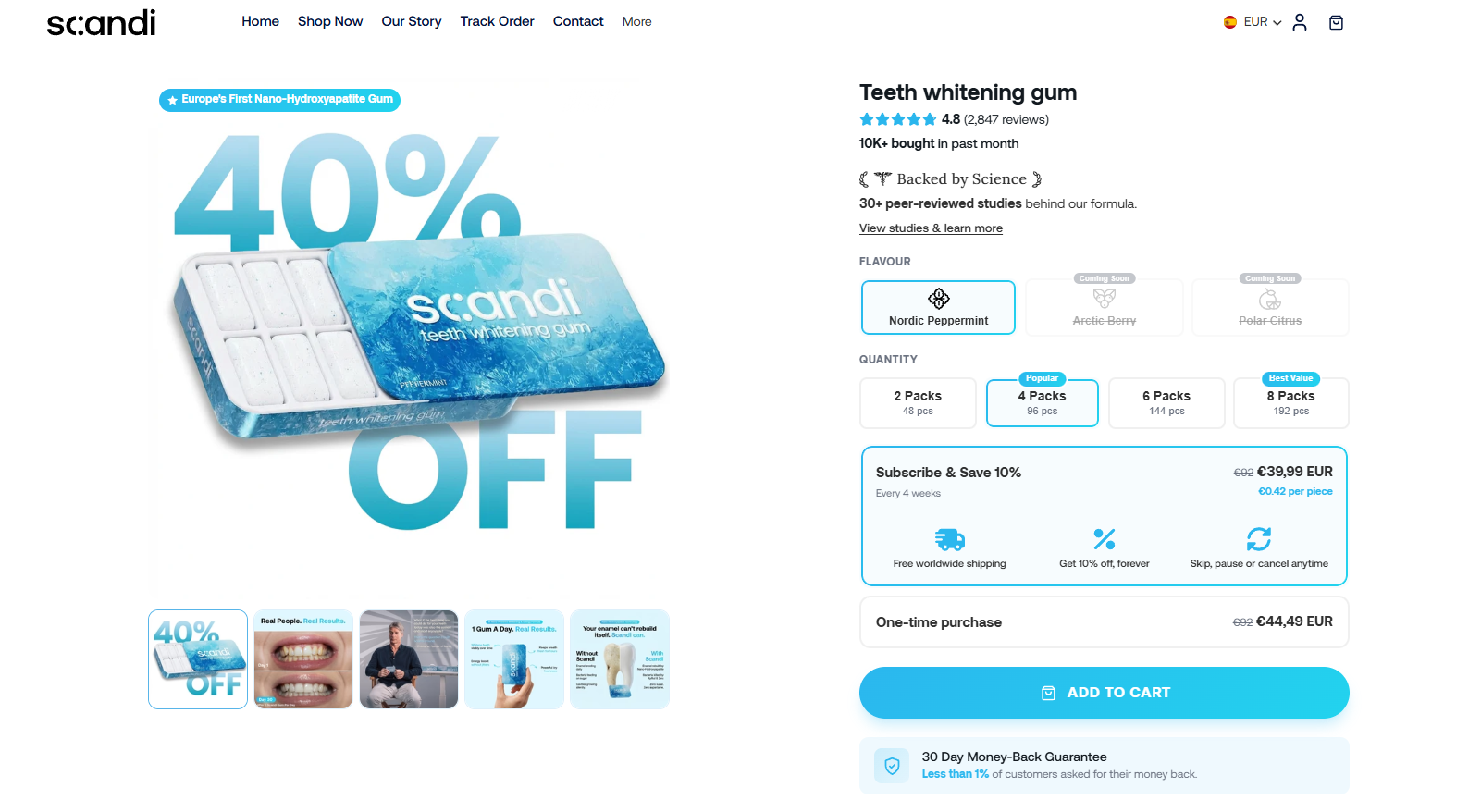
Scandigum is built specifically around the biology we have been discussing in this article. The formula leverages buccal absorption for faster ingredient delivery, xylitol for active enamel support, and the mastication-brain loop to prime your prefrontal cortex before the demands of your day hit. It is not a flavor product. It is a delivery system designed around what your brain and mouth actually need. If you want to try functional chewing gum that takes the science seriously, this is where to start.
Frequently asked questions
Does chewing gum really improve attention and focus?
Yes. Studies confirm that chewing produces measurable theta power increases in the brain, directly improving performance on sustained attention and working memory tasks, particularly during longer focus sessions.
What type of gum is best for cognitive benefits?
Sugar-free gum with xylitol is the best choice. It delivers the mastication-driven arousal effect while also reducing caries and stimulating salivation, making it the only format that supports both brain and dental health simultaneously.
Are there any downsides to chewing gum for cognitive enhancement?
The main limitation is inconsistency. A review of 26 studies found that effects are not robust across all tasks or individuals, and some studies reported adverse effects on certain cognitive measures, so results vary.
How quickly do cognitive benefits appear after starting to chew gum?
Alertness improvements can appear within minutes. Research shows reduced vigilance errors and faster reaction times in the later stages of focus tasks, suggesting the effect builds as you chew rather than hitting all at once.