

TL;DR:
- Saliva is essential for oral health, aiding in cleansing, neutralizing acids, and remineralizing enamel.
- Age, hormones, medications, and health conditions can reduce saliva flow, increasing dental risks.
- Chewing sugar-free gum and staying hydrated effectively boost saliva production and improve oral comfort.
Your body produces between 0.5 and 1.5 liters of saliva every single day. That’s roughly the volume of a large water bottle, quietly working in the background to protect your teeth, fight bacteria, and keep your mouth comfortable. Most people think brushing and flossing are the pillars of oral health. They are important, but saliva is the silent system running underneath all of it. After 30, that system starts to slow down, and the consequences show up in ways you might not immediately connect to your mouth.
Table of Contents
- Why saliva matters for a healthy mouth
- How saliva protects your teeth and gums
- Salivary flow: What’s normal, what’s low, and why it matters after 30
- Boosting saliva flow: Effective, innovative solutions for adults 30+
- Our perspective: Why saliva should be the first thing you optimize for oral health
- Try innovative chewing solutions for a healthier smile
- Frequently asked questions
Key Takeaways
| Point | Details |
|---|---|
| Saliva is essential | It protects teeth, gums, and comfort by cleaning, buffering acids, and kicking off repairs. |
| Aging lowers flow | After age 30, saliva production often drops, increasing oral health risks. |
| Chewing stimulates saliva | Sugar-free gums—especially with xylitol or stevia—effectively boost saliva flow for most adults. |
| Watch for dry mouth signs | Problems like persistent dryness, bad breath, or discomfort may signal you need more saliva support. |
| Innovative solutions help | Using targeted chewing products can safely and easily promote better oral health over time. |
Why saliva matters for a healthy mouth
With that surprising daily output in mind, let’s explore exactly why this liquid is essential for your dental well-being.
Saliva is not just moisture. It is a biochemically active fluid that performs several jobs at once. Saliva maintains oral health through cleansing, acid neutralization, remineralization, antimicrobial action, lubrication, and buffering. Every time you eat, drink, or simply breathe through your mouth, saliva is working to restore balance.
The chemistry here matters. Your mouth is healthiest when its pH stays between 6.0 and 7.5. That slightly neutral range keeps enamel stable. When you eat sugary or acidic foods, oral bacteria produce acids that push pH below 5.5, the critical threshold where enamel begins to break down. Saliva steps in with its buffer systems, primarily bicarbonate and phosphate ions, to neutralize those acids and push pH back up. Understanding mouth chemistry and teeth helps explain why this buffering action is so central to long-term dental health.
Saliva also contains mucins, large glycoproteins that coat and lubricate the oral tissues. Without enough mucin coverage, your cheeks, gums, and tongue feel raw and sticky. That discomfort is not just unpleasant. It is a signal that your mouth’s first line of defense is compromised.
Here is a quick breakdown of what saliva actually does for you every day:
- Cleanses food debris and bacteria from tooth surfaces
- Neutralizes acids produced by oral bacteria after meals
- Remineralizes early enamel damage by delivering calcium and phosphate ions
- Lubricates soft tissues with mucins to prevent irritation
- Fights pathogens using antimicrobial proteins like lysozyme and lactoferrin
- Assists digestion by breaking down starches with amylase
Stat to know: Adults with consistently low saliva levels are significantly more likely to develop cavities, gum disease, and oral infections compared to those with healthy flow rates.
Pro Tip: If your mouth feels dry or sticky by mid-morning, that is often a hydration signal. Drink water steadily throughout the day rather than in large gulps, and pay attention to whether the feeling persists even after drinking.
How saliva protects your teeth and gums
Understanding what saliva does sets the foundation, but how does it actually defend your teeth and gums each day?
The mechanical action starts immediately. Every swallow sweeps bacteria and food particles away from tooth surfaces and into the digestive tract. This constant flushing action reduces the time harmful bacteria spend in contact with enamel. Less contact time means less acid exposure and less erosion.

Chemically, the bicarbonate and phosphate buffer systems in saliva prevent demineralization below pH 5.5. When enamel does lose minerals during an acid attack, saliva reintroduces calcium and phosphate ions that redeposit into the enamel lattice. This is remineralization, and it happens passively every time your saliva is flowing at a healthy rate.
Salivary deficiency increases risks of caries, periodontal disease, and oral infections, with higher prevalence in adults over 65 reaching 30 to 40%. But the risk does not wait until your 60s. It builds gradually, which is why the habits you build in your 30s and 40s matter enormously.
Learning more about chewing and saliva benefits can help you understand how simple mechanical stimulation amplifies these protective effects.
| Factor | Normal saliva flow | Reduced saliva flow |
|---|---|---|
| Cavity risk | Low | High |
| Gum disease risk | Low | Moderate to high |
| Oral infection risk | Low | Elevated |
| Enamel repair | Active | Impaired |
| Mouth comfort | Good | Poor |
“Saliva is arguably the most important protective factor in the oral environment. Its absence, even partial, accelerates nearly every form of dental disease.” — Oral health research consensus
Watch for these signs that your saliva production may be falling short:
- Persistent dry or sticky feeling in the mouth
- Frequent bad breath despite regular brushing
- Difficulty chewing or swallowing dry foods
- Cracked lips or sore corners of the mouth
- A burning or tingling sensation on the tongue
- Increased sensitivity in teeth
Salivary flow: What’s normal, what’s low, and why it matters after 30
Once you know saliva’s importance, it is crucial to recognize if yours is in a healthy range, especially as you get older.
A normal unstimulated flow rate sits between 0.3 and 0.4 mL per minute. Hyposalivation, the clinical term for low saliva production, is defined as flow at or below 0.1 to 0.3 mL per minute. That gap might sound small, but the difference in oral health outcomes is significant.
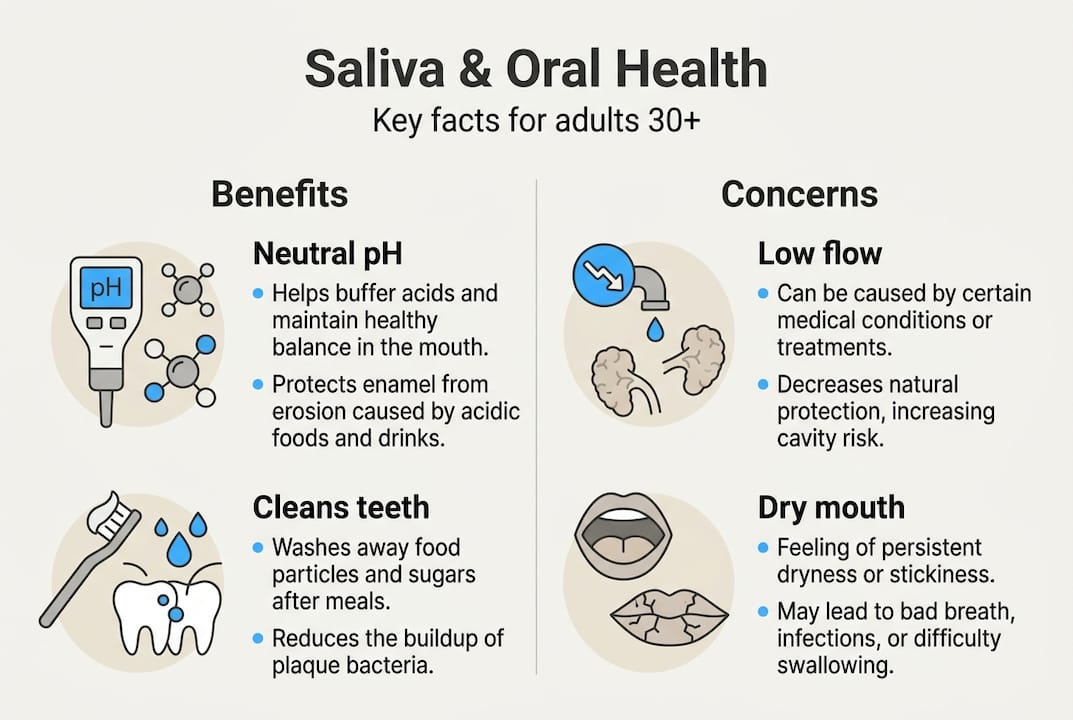
Age is one of the biggest drivers of declining flow. After 30, a combination of factors starts to reduce saliva output gradually. For women, hormonal shifts around perimenopause and menopause are particularly impactful. Postmenopausal women show reduced flow averaging 0.2 mL per minute compared to 0.4 mL per minute in premenopausal women, and that reduction correlates directly with higher oral discomfort scores.
| Group | Avg. unstimulated flow | Oral discomfort level |
|---|---|---|
| Premenopausal women | 0.4 mL/min | Low |
| Postmenopausal women | 0.2 mL/min | Moderate to high |
| Adults with hyposalivation | ≤0.1 mL/min | High |
The effects of medications on saliva are also a major and often overlooked contributor. Many common prescriptions reduce flow as a side effect.
Here are the key reasons saliva declines with age:
- Hormonal changes including estrogen and testosterone shifts that affect gland function
- Medications such as antihistamines, antidepressants, diuretics, and blood pressure drugs
- Chronic health conditions including diabetes, autoimmune disorders, and Sjögren’s syndrome
- Mouth breathing which dries oral tissues and reduces effective saliva coverage
- Dehydration from insufficient water intake, caffeine, or alcohol consumption
Stat to know: Adults taking three or more daily medications have a substantially higher risk of clinically low saliva flow, regardless of age.
Boosting saliva flow: Effective, innovative solutions for adults 30+
If your goal is to keep your smile healthy and comfortable, what actionable steps can you take starting today?
The most immediate and well-researched tool is mechanical stimulation through chewing. Chewing sugar-free gum stimulates saliva flow, aiding remineralization and pH neutralization, and is recognized as effective for xerostomia (dry mouth) relief. The act of chewing activates the salivary glands directly, producing a rapid and measurable increase in output.
How significant is that increase? Stimulated saliva flow during chewing can reach up to 7.8 times the resting rate. That is not a marginal boost. It is a meaningful shift in your oral environment, one that actively works to neutralize acids and support enamel repair in real time.
When it comes to ingredient choice, xylitol and stevia gums are equivalent in their ability to boost salivary flow and raise oral pH, making both excellent options for adults over 30 seeking a non-invasive, daily solution. Neither sweetener feeds the bacteria that produce cavity-causing acids, which makes them far superior to sugar-sweetened alternatives.
Learn more about how chewing for saliva stimulation fits into a complete oral health routine.
Here are your top daily options for boosting saliva naturally:
- Sugar-free gum with xylitol or stevia: Chew for 15 to 20 minutes after meals for maximum flow stimulation
- Consistent hydration: Sip water throughout the day, not just when thirsty
- Crunchy whole foods: Raw vegetables and fruits mechanically stimulate the glands
- Reduce mouth breathing: Nasal breathing preserves oral moisture more effectively
- Limit caffeine and alcohol: Both are diuretics that reduce systemic hydration
Pro Tip: Look for gums that list xylitol or stevia as the primary sweetener and keep the ingredient list short. Gums loaded with artificial colors, flavors, and fillers add nothing to your oral health and may irritate sensitive tissues.
Our perspective: Why saliva should be the first thing you optimize for oral health
With practical steps in hand, here is a big-picture view that most oral health guides and even dental professionals rarely emphasize.
The oral care industry is built around products you apply to your teeth. Toothpaste, mouthwash, whitening strips. These are all external interventions. They work on the surface. But saliva works from within, continuously, for free, using your own biology. The fact that it barely gets mentioned in mainstream dental advice is, frankly, a gap worth addressing.
We have seen firsthand that people who prioritize saliva stimulation, through better hydration, smarter chewing habits, and the right gum choices, often notice improvements in comfort and sensitivity that no paste or rinse delivered on its own. It is not that brushing does not matter. It absolutely does. But saliva is the environment in which all of that brushing either succeeds or fails.
Here is a real challenge: commit to two weeks of focusing on the power of chewing gum and hydration as your primary oral health levers. Chew sugar-free gum after meals, drink water consistently, and track how your mouth feels. Most people are surprised by the difference. Your biology is already set up to protect your teeth. Give it the conditions it needs to do the job.
Try innovative chewing solutions for a healthier smile
If saliva’s benefits have surprised you, here is an easy way to implement these solutions right away.
Scandigum is built around exactly this principle: that the act of chewing is a delivery mechanism, not just a habit. Our formulas are designed to work with your salivary biology, stimulating flow, supporting remineralization, and optimizing the oral environment with every chew.
If you are ready to move beyond basic brushing and give your oral health a genuine upgrade, explore the chewing options from Scandi Gum and find the formula that fits your daily routine. Your saliva is already doing the work. We just help it do more.
Frequently asked questions
How do you know if you have low saliva flow?
Persistent dryness, a sticky mouth, frequent thirst, and difficulty swallowing dry foods are common signs of hyposalivation. A dentist can measure your unstimulated flow rate if you want a clinical confirmation.
Can chewing gum really prevent cavities?
Yes. Sugar-free gum with xylitol or stevia reduces cavity risk by stimulating saliva, which neutralizes harmful acids and supports enamel repair after meals.
What can cause dry mouth besides age?
Medications, dehydration, and health conditions like diabetes or Sjögren’s syndrome are leading causes. Medication-induced xerostomia is particularly common in adults between 45 and 64 and is often underdiagnosed.
Does drinking water increase saliva?
Staying hydrated supports the conditions needed for healthy saliva production, but water alone may not correct flow issues caused by medications or systemic health conditions. Chewing and oral pH balance are equally important levers to pull.