

TL;DR:
- Chewing activates neural circuits linked to dopamine release, cognitive focus, and brain blood flow, impacting long-term brain health.
- Oral health issues like tooth loss and gum disease disrupt these circuits, increasing the risk of cognitive decline and neurodegeneration.
Chewing is one of the most automatic things you do, yet how masticatory actions affect the brain goes far deeper than breaking down food. Every jaw movement sends signals through neural circuits tied to dopamine release, cortisol regulation, and cerebral blood flow. This is not a digestion story. It is a neuroscience story. The research now connects chewing quality directly to cognitive performance, dementia risk, and even your daily capacity for focused attention. If you care about what your brain does today and decades from now, what happens in your mouth deserves a hard look.
Table of Contents
- The neural circuit linking chewing to brain reward centers
- How masticatory deficits relate to cognitive decline
- The oral–gut–brain axis: inflammation and neurodegeneration links
- Chewing and enhanced cognitive focus: what the science shows
- Aging, tooth loss, and the impact on mastication–brain health pathways
- Why chewing is a cognitive health pillar often overlooked
- Support your brain with mindful chewing and functional products
- Frequently asked questions
Key Takeaways
| Point | Details |
|---|---|
| Chewing activates brain reward circuit | Masticatory actions stimulate dopamine neurons in the midbrain, reinforcing motivated behavior. |
| Poor mastication links to cognitive decline | Tooth loss and chewing deficits are strongly associated with reduced cognitive function and dementia risk. |
| Oral health impacts brain inflammation | Periodontitis triggers systemic inflammation via the oral-gut-brain axis, contributing to neurodegeneration. |
| Chewing boosts focus and alertness | Chewing gum supports sustained attention and cortical activity, enhancing task performance. |
| Aging challenges mastication and cognition | Neuronal loss and dietary changes from tooth loss disrupt chewing rhythms, impairing brain health. |
The neural circuit linking chewing to brain reward centers
Most people assume chewing is a reflex. Bite, grind, swallow. But masticatory neural activation is far more deliberate in its neurological effects than anyone expected until recently.
Research has confirmed that masticatory actions like gnawing activate a neural circuit connecting touch-sensitive neurons around the teeth to dopamine neurons in the midbrain, triggering dopamine release in the nucleus accumbens. The nucleus accumbens is the brain’s primary reward hub. It is the same region activated by food, social connection, and goal achievement. Chewing has direct access to it.
“The fact that oral sensory input reaches the brain’s reward center reframes chewing as a motivated behavior, not just a mechanical one. Your brain is reinforcing the act of chewing the same way it reinforces behaviors essential to survival.”
This explains more than you might realize. Human repetitive oral habits, from chewing gum during stress to the universal urge to crunch something satisfying, are not quirks. They are expressions of a dopamine-linked feedback loop. The brain rewards you for chewing because, evolutionarily, chewing meant food, and food meant survival.
The practical implication here is significant. If your oral sensory input is compromised by tooth loss, poor dental health, or soft-food diets, you are sending fewer signals to this circuit. Less input means less dopamine reinforcement. And that has downstream effects on motivation and mood that extend well beyond the dinner table.
How masticatory deficits relate to cognitive decline
The connection between chewing quality and cognitive health is no longer theoretical. Clinical and epidemiological data point in a consistent direction.
A bibliometric review found a positive association between masticatory deficits like tooth loss and cognitive decline in 45% of reviewed studies, a number that becomes striking when you consider how rarely oral health appears in standard cognitive risk assessments. Separately, oral frailty including chewing difficulties is associated with increased risk of cognitive impairment in older adults.
Key findings from the research:
- Tooth loss correlates with lower scores on standard cognitive assessments including memory and executive function tests
- Adults with fewer than 20 natural teeth show measurably higher dementia incidence in long-term cohort studies
- Chewing difficulties often compound with reduced caloric intake, creating nutritional deficits that further impair brain function
- The relationship appears bidirectional: cognitive decline also reduces the attention and coordination needed for proper mastication
| Masticatory status | Associated cognitive risk |
|---|---|
| Full dentition, normal chewing | Baseline cognitive aging trajectory |
| Moderate tooth loss (10 to 19 teeth) | Elevated dementia risk, reduced memory scores |
| Severe tooth loss (under 10 teeth) | Significantly higher cognitive impairment risk |
| Complete edentulism without prosthetics | Strongest association with accelerated cognitive decline |
The mechanism here is not fully linear. Chewing deficits often coexist with aging, social isolation, reduced physical activity, and poorer nutrition, all of which independently harm the brain. But oral health and cognition share more than a correlation. The biology runs deeper.
The oral–gut–brain axis: inflammation and neurodegeneration links
Here is where the science gets particularly compelling for anyone tracking neurodegeneration risk. Poor oral health does not just reduce chewing efficiency. It introduces a cascade of systemic inflammation that reaches the brain.
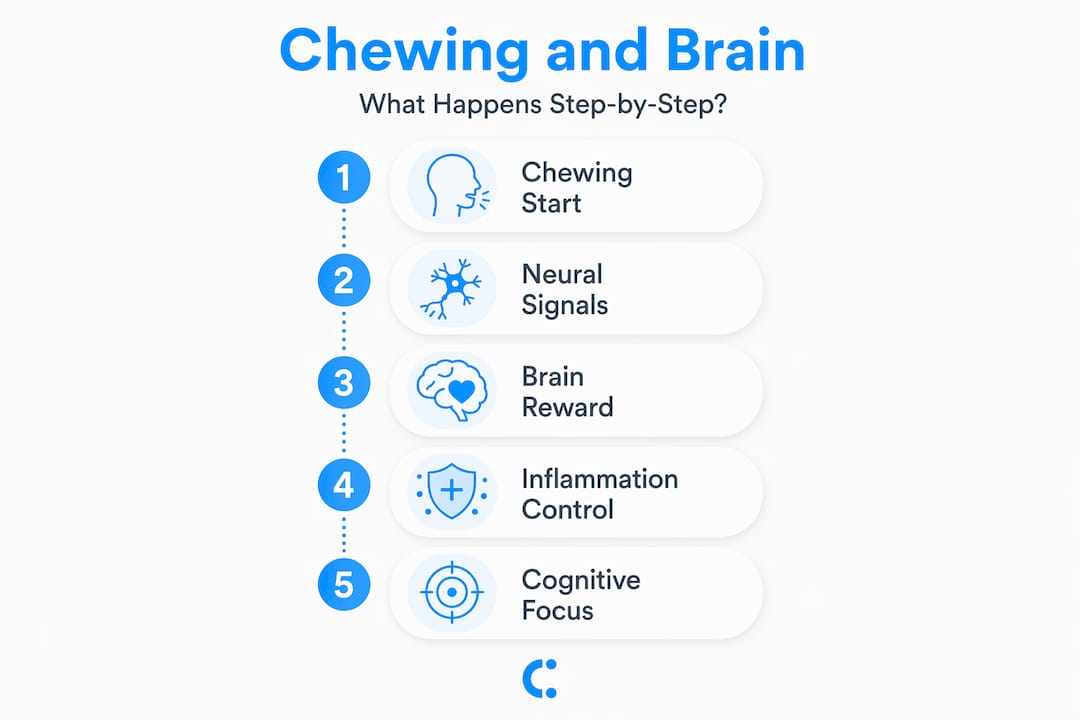
Periodontitis impairs masticatory function and is associated with neurodegenerative diseases via an oral–gut–brain inflammatory axis. Periodontitis, a severe form of gum disease, affects roughly 19% of adults globally. The bacteria responsible do not stay local.
How the inflammatory cascade works:
- Oral pathogens like Porphyromonas gingivalis enter the bloodstream through inflamed gum tissue
- These pathogens disrupt the gut microbiome, increasing intestinal permeability (“leaky gut”)
- Systemic inflammatory markers rise, including C-reactive protein and interleukin-6
- Neuroinflammation follows, with microglia activation in the brain linked to Alzheimer’s and Parkinson’s pathology
Why this matters for your daily chewing:
- Maintaining masticatory function preserves gum tissue contact and supports saliva flow, which buffers bacterial overgrowth
- Saliva contains antimicrobial compounds that suppress the pathogens responsible for this inflammatory chain
- Reduced chewing means reduced saliva production, removing a frontline defense against the very bacteria that trigger neuroinflammation
Salivary biomarkers are now being studied as non-invasive indicators of neuroinflammatory risk, which means the biological feedback loop between your mouth and your brain is measurable in real time. The oral inflammation brain health connection is no longer a hypothesis. It is a documented mechanistic pathway.
Chewing and enhanced cognitive focus: what the science shows
Set aside disease risk for a moment. What does chewing do for a healthy brain right now, today, during a demanding work session?
The relationship between chewing and brain activity shows up clearly in performance research. Chewing gum helps focus on tasks requiring sustained attention, with chewers consistently outperforming non-chewers in the later stages of cognitive tasks. That last detail matters. Benefits are not immediate. They build as the masticatory rhythm sustains blood flow and neurotransmitter signaling over time.
Mastication modulates cortical activity and helps maintain cognitive function, while poor chewing correlates with more systemic diseases in older adults. The cortical effects include increased activation in the prefrontal cortex, the region governing decision-making, working memory, and impulse control.
Documented cognitive effects of regular mastication:
- Increased cerebral blood flow to the hippocampus and prefrontal cortex during and after chewing
- Reduced salivary cortisol, lowering the stress response that degrades working memory
- Stimulation of the reticular activating system via the trigeminal nerve, promoting alertness without stimulant dependency
- Enhanced chewing cognitive benefits peak at roughly 20 minutes of sustained chewing before masticatory muscle fatigue reduces the signal
Pro Tip: If you use chewing gum and attention strategies before focused work, aim for a sustained 15 to 20-minute chew rather than a quick two-minute session. The neural arousal effect accumulates. Short chews deliver minimal cortical activation.
Aging, tooth loss, and the impact on mastication–brain health pathways
Aging introduces a compounding problem. The very neurons responsible for regulating chewing rhythm decline with age, and the teeth that generate sensory input disappear at the same time.

Aging and tooth loss cause Piezo2 downregulation and mesencephalic trigeminal neuron death, disrupting masticatory rhythm and potentially contributing to cognitive decline. Piezo2 is a mechanosensory protein in teeth that detects bite force and feeds that information to the brain. Lose your teeth, lose those sensors. Lose those sensors, and the neural feedback loop that supports everything from dopamine signaling to cortical arousal becomes weaker.
| Factor | Effect on younger adults | Effect on older adults |
|---|---|---|
| Tooth loss | Rare, localized impact | Widespread, affects chewing pattern and diet range |
| Masticatory muscle tone | Maintained through use | Declines with reduced chewing frequency |
| Neuronal signaling from teeth | Strong Piezo2 activation | Reduced due to downregulation and neuron death |
| Diet diversity | Unaffected by mild loss | Restricted to softer foods, reducing nutrient variety |
| Cognitive impact | Minimal short-term effect | Accelerated decline risk via neural and nutritional pathways |
Poor chewing performance from tooth loss restricts diet to softer foods, reducing intake of neuroprotective nutrients and worsening cognitive outcomes in elderly individuals. Omega-3 fatty acids, vitamin K2, and flavonoid-rich foods are among the hardest to consume on a soft diet. These are precisely the nutrients most robustly linked to reduced neurodegeneration.
Pro Tip: For older adults or anyone with significant dental work, maintaining aging mastication brain health through consistent masticatory activity, whether with functional gum, firm foods, or jaw exercise, can meaningfully preserve both the neural feedback loop and dietary range.
Why chewing is a cognitive health pillar often overlooked
The conventional wellness narrative assigns cognitive health to sleep, exercise, nutrition, and meditation. Mastication does not appear on that list. That is a real gap.
Here is what actually happens when you chew: you activate an integrated neural circuit that triggers dopamine reward, increases prefrontal blood flow, stimulates the trigeminal nerve, suppresses cortisol, and maintains sensory pathways that the brain depends on for arousal and motivation. That is not a minor biological footnote. That is a cognitive support system running quietly every time you eat.
The problem is that chewing is invisible in the wellness conversation precisely because it feels automatic. But automatic does not mean inconsequential. Breathing is automatic too, and nobody argues against breath training for cognitive performance.
Masticatory-related dopamine circuits actively reinforce chewing behavior, linking oral sensory input and brain reward to cognition. This means neglecting oral health, reducing chewing frequency through ultra-processed soft food diets, or allowing tooth loss to go unmanaged does not just affect your mouth. It actively reduces the volume of input your brain’s reward and attention systems receive every single day.
The cognitive role of chewing deserves the same deliberate attention you give to a morning supplement stack or a sleep routine. Preserving masticatory function is, in measurable neurological terms, preserving brain function. The people who figure this out early have a meaningful advantage in cognitive resilience as they age.
Support your brain with mindful chewing and functional products
The science points clearly toward one conclusion: protecting and actively using your masticatory system is a cognitive health strategy, not just a dental one. Every chewing session that engages your jaw, stimulates saliva flow, and fires sensory neurons is a direct investment in your brain’s reward circuits, attention systems, and long-term structural health.
Scandigum is built around exactly this biology. Rather than treating chewing as incidental, our functional chewing gum options work with the mastication-brain loop to deliver buccal absorption of active compounds, support enamel remineralization, and sustain the neural arousal that focused work demands. If you want to understand how to improve chewing for brain health and put these mechanisms to practical use, start with your daily habits and what you choose to chew.
Frequently asked questions
How does chewing influence dopamine release in the brain?
Chewing activates touch-sensitive neurons around the teeth that signal dopamine neurons in the midbrain, and this sensory-to-dopamine pathway triggers dopamine release in the nucleus accumbens, the brain’s core reward center. This makes chewing a behaviorally reinforced action, not just a reflex.
Can poor chewing function lead to cognitive decline?
Yes. A positive association exists between masticatory deficits such as tooth loss and cognitive decline, with multiple study designs linking reduced chewing function to increased dementia risk and lower scores on standard cognitive assessments.
What role does oral health play in brain inflammation?
Oral diseases like periodontitis introduce pathogens into the bloodstream that disrupt gut integrity and increase neuroinflammation. This oral–gut–brain inflammatory axis provides a documented mechanistic link between gum disease and neurodegenerative disease risk.
Does chewing gum improve mental focus?
Yes. Research shows chewing gum improves attention on tasks requiring sustained concentration, with chewers outperforming non-chewers particularly in the later stages of demanding cognitive tasks. Benefits peak around 20 minutes of consistent chewing.
How does aging affect the relationship between chewing and brain health?
Aging-related tooth loss triggers Piezo2 downregulation and neuron death in the trigeminal system, disrupting the sensory feedback loop that supports chewing rhythm and cognitive arousal while simultaneously restricting diet diversity and neuroprotective nutrient intake.