

TL;DR:
- Chewing enhances metabolism, increases thermogenesis, and supports glucose regulation when done thoroughly.
- It stimulates neural activity, boosting alertness and cognitive performance through trigeminal nerve engagement.
- Oral health impacts chewing benefits; healthy dentition maximizes energy and brain response.
Most people think of chewing as background noise in their day, the thing your jaw does while your mind is somewhere else. That’s a missed opportunity. The act of chewing triggers a cascade of physiological events that reach far beyond your mouth: it shifts your metabolism, redirects blood flow to your brain, and can even alter how alert you feel within minutes. This article breaks down the mechanisms behind chewing’s energy and cognitive effects, examines what the latest research actually shows (including where the evidence gets complicated), and explains how to use this knowledge to support your energy, focus, and oral health with precision.
Table of Contents
- How chewing triggers energy and metabolic effects
- Chewing’s impact on brain energy and alertness
- When chewing boosts cognition and when it doesn’t
- Functional chewing for targeted energy and oral health
- Why understanding chewing’s energy role changes the game
- Boost your energy with functional chewing
- Frequently asked questions
Key Takeaways
| Point | Details |
|---|---|
| Chewing boosts metabolism | Chewing longer and more thoroughly increases post-meal energy expenditure by activating diet-induced thermogenesis. |
| Improves alertness and focus | Chewing activates neural pathways for brain blood flow and oxygen, leading to temporary improvements in vigilance and attention. |
| Functional chewing delivers nutrients | Chewing makes energetic and functional ingredients like nitrate more bioavailable than swallowing alone. |
| Oral health matters | Optimal energy and cognitive benefits from chewing require healthy teeth and gums for maximum effect. |
| Smart product choices maximize gains | Choosing dentist-approved, sugar-free chewing products enhances both energy and oral wellness. |
How chewing triggers energy and metabolic effects
With this new context, let’s look closer at how chewing directly affects your energy levels.
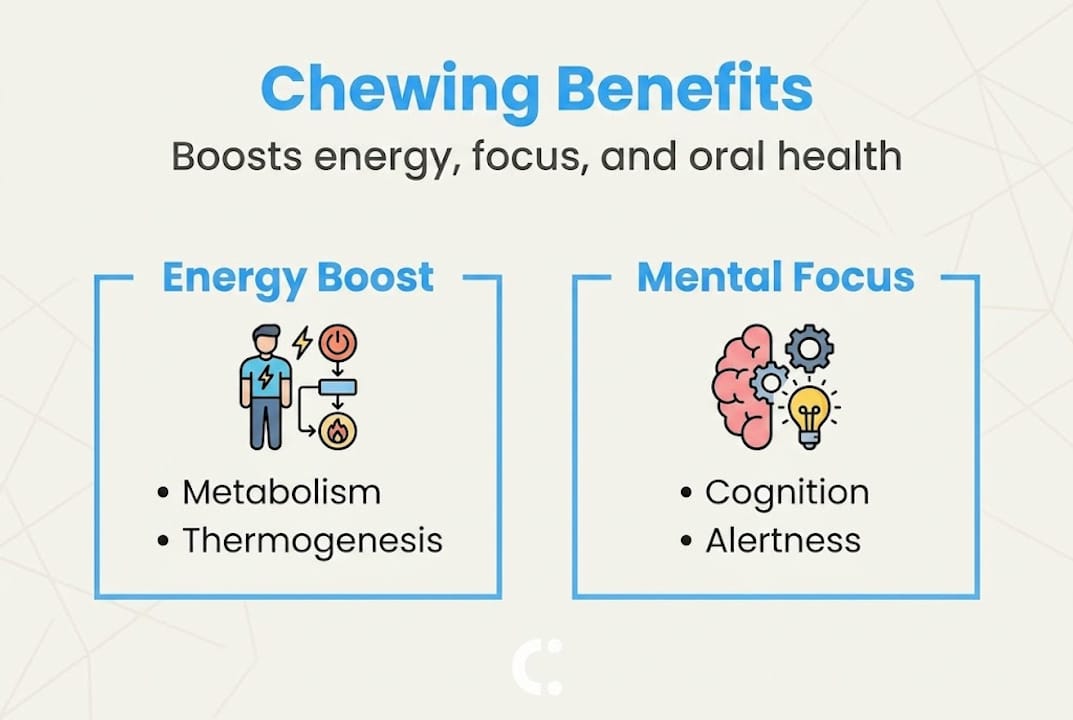
Most people associate energy expenditure with exercise, sleep, or nutrition. Chewing rarely enters that conversation. But a closer look at the physiology reveals that the act of mastication (the technical term for chewing) is genuinely tied to how your body processes and expends energy after a meal.
Diet-induced thermogenesis refers to the energy your body burns digesting, absorbing, and processing food. It typically accounts for about 10% of your total daily energy expenditure. What many people don’t realize is that how you chew plays a meaningful role in how pronounced this thermogenic response becomes. Chewing increases postprandial diet-induced thermogenesis, and the evidence links eating slowly and chewing thoroughly to the insulin secretion mechanisms that regulate how your body handles fuel after eating.
The practical implication is significant. When you chew more thoroughly and extend the duration of your meal, you give your gut-brain axis more time to signal satiety, modulate insulin release, and sustain thermogenic activity. Speed-eating effectively short-circuits this process.
Here’s a breakdown of how chewing behavior influences key metabolic markers:
| Chewing behavior | Effect on metabolism | Effect on insulin response |
|---|---|---|
| Fast, minimal chewing | Lower thermogenesis | Blunted, delayed signaling |
| Slow, thorough chewing | Higher thermogenesis | More regulated, timely response |
| Functional chewing (gum) | Stimulates salivary flow | Primes digestive readiness |
| Extended chew duration | Increases total energy cost | Supports glucose homeostasis |
Several key mechanisms drive this effect:
- Salivary amylase activation: Thorough chewing triggers the release of amylase, which begins breaking down carbohydrates in the mouth and signals downstream digestive organs to prepare.
- Increased meal duration: Longer chewing extends the window for gut-derived hormones like GLP-1 and PYY to signal satiety, preventing overconsumption.
- Jaw muscle thermogenesis: The masseter and temporalis muscles (your primary chewing muscles) consume oxygen and generate heat during sustained chewing, contributing to caloric burn.
- Insulin sensitivity support: Slower chewing creates a steadier glucose curve post-meal, which reduces the metabolic cost of large, sudden insulin releases.
Pro Tip: If you’re using functional chewing products for energy, try to chew slowly and deliberately for the first few minutes. The physical engagement itself amplifies the metabolic response, not just the ingredients inside.
Understanding chewing gum energy benefits goes beyond calories burned. It’s about training your body to work with food, not against it, by using the one interface you already have: your jaw.
Chewing’s impact on brain energy and alertness
Beyond metabolic shifts, chewing can also spark changes in mental energy and alertness.
The connection between your jaw and your brain is more direct than most people expect. The trigeminal nerve, one of the largest cranial nerves, runs from the jaw directly to the brainstem and connects to the reticular activating system, which is the neural network responsible for regulating wakefulness and attention. When you chew, you’re essentially sending a rhythmic electrical signal to your brain’s alertness center. That’s not a metaphor. That’s anatomy.

Chewing improves performance on cognitive vigilance tasks and is linked to measurable changes in brain connectivity, as seen in functional imaging studies. Specifically, regions associated with executive function and sustained attention show increased activation during and shortly after chewing.
Here’s how chewing stacks up against swallowing when it comes to brain activation:
| Factor | Chewing | Swallowing only |
|---|---|---|
| Trigeminal nerve stimulation | High | Minimal |
| Prefrontal cortex blood flow | Increased | No significant change |
| Duration of alertness effect | 15 to 20 minutes | Brief |
| Sensory feedback to brain | Rich (texture, resistance) | Absent |
| Cognitive performance impact | Measurable improvement | Negligible |
How exactly does this process unfold? Consider these steps:
- Jaw movement initiates trigeminal firing: Each chew sends afferent (incoming) signals through the trigeminal nerve to the brainstem.
- Reticular activating system engages: The brainstem activates ascending arousal pathways, increasing global cortical alertness.
- Cerebral blood flow redistributes: Oxygenated blood moves preferentially to the prefrontal cortex, the region you rely on for decision-making, working memory, and focus.
- Local muscle work contributes: The sustained muscular effort of chewing slightly increases heart rate, which amplifies cerebral perfusion.
- Sensory feedback sustains the effect: The texture and resistance of what you’re chewing provide continuous sensory input that keeps these neural pathways active.
“The evidence suggests that chewing is not merely a preparatory act for digestion but an active stimulus for cognitive arousal, with measurable effects on attention and neural connectivity.” This framing from recent neuroimaging research underscores why chewing for focus is no longer just a productivity hack, it’s a documented neurological phenomenon.
The practical upshot: a 15 to 20 minute chewing session with a functional product isn’t just delivering ingredients to your bloodstream. It’s running a low-grade neural stimulation protocol on your prefrontal cortex. The ingredient delivery and the physical act of chewing compound each other.
When chewing boosts cognition and when it doesn’t
While chewing offers energy and mental perks, not all scenarios yield the same results.
The research on chewing and cognition is genuinely exciting, but it would be intellectually dishonest to present it as a clean, universally positive story. The truth is more nuanced, and understanding that nuance is what separates smart users from people who chase trends without results.
A thorough review of the literature shows that chewing’s cognitive effects are not universally robust, with some studies reporting null or even slightly negative outcomes depending on the task type, the study population, and the chewing protocol used. This doesn’t undermine the case for functional chewing. It sharpens it.
Several variables determine whether chewing delivers a cognitive lift or a flat line:
- Task type matters enormously: Chewing tends to help most on sustained attention and vigilance tasks (reading, monitoring, focused work). It may interfere with tasks that require verbal working memory because the rhythmic jaw movement can compete with inner speech.
- Chewing style and product: Hard, continuous chewing differs neurologically from gentle, rhythmic chewing. Flavor and sensory intensity also influence how much neural feedback the brain receives, which affects the arousal response.
- Timing relative to the task: Chewing during a demanding cognitive task sometimes helps, sometimes hurts. Chewing before a task tends to produce more consistent positive results.
- Individual sensory sensitivity: People with high sensory thresholds may need more intense oral stimulation to achieve the same arousal response.
- Study design quality: Many older studies used small samples, uncontrolled variables, or non-functional gum. The evidence base has improved, but variability in methodology still contributes to inconsistent findings.
“Cognitive benefits from chewing appear most reliable when the task demands sustained attention rather than complex verbal processing, and when chewing precedes rather than runs concurrent with the task.”
Understanding chewing mechanism insights at the biomechanical level also helps explain variability. Jaw muscle fiber recruitment, bite force, and chewing frequency all influence the intensity of trigeminal stimulation, which means two people chewing the same product can generate meaningfully different neural responses.
The takeaway isn’t “chewing doesn’t work.” It’s “chewing works best when conditions align.” For anyone seeking chewing for sharper focus, the most reliable protocol is to chew before a focused task, use a product with meaningful texture and functional ingredients, and avoid concurrent verbal memory demands.
Pro Tip: If you notice chewing interfering with concentration during a task that requires a lot of internal speech (writing, memorizing, verbal problem-solving), pause the chew and resume during breaks. The pre-task window is your most reliable cognitive leverage point.
Functional chewing for targeted energy and oral health
To maximize chewing’s potential, consider the products and your oral health status.
Here’s where the science shifts from interesting to actionable. Chewing isn’t just a mechanical stimulus. It’s also a delivery mechanism, and when that mechanism is paired with the right functional substrate, the results exceed what either chewing or the ingredient could achieve alone.
A compelling example comes from research on nitrate delivery. Chewing encapsulated arugula extract increased NO and NO3 levels more effectively than swallowing the same extract in capsule form. Nitric oxide (NO) is a vasodilator that increases blood flow to muscles and the brain, which makes it a genuine energy-supporting compound. The buccal mucosa (the lining of your cheeks and inner gums) is highly vascularized, meaning compounds absorbed there bypass the digestive tract and liver metabolism entirely. The result is faster onset and higher bioavailability.
| Delivery method | Onset of effect | Bioavailability | NO/NO3 increase |
|---|---|---|---|
| Swallowed capsule | 30 to 90 minutes | Reduced by liver metabolism | Moderate |
| Chewed functional product | 5 to 15 minutes | High (buccal absorption) | Significantly higher |
| Energy drink | 15 to 45 minutes | Moderate | Ingredient-dependent |
| Functional chewing gum | 10 to 20 minutes | High | Compound-dependent |
But there’s a critical limiting factor that the research is now starting to quantify: oral health status. Malocclusion and tooth loss can reduce chewing-induced brain blood flow and impair the cognitive markers that chewing typically supports. If the jaw can’t generate adequate bite force or sustained rhythm, the trigeminal stimulation is weaker, the muscular thermogenic contribution drops, and the delivery of buccal-absorbed ingredients becomes inconsistent.
Key considerations for functional chewing efficacy:
- Healthy dentition supports stronger trigeminal signaling: Adequate molar contact is necessary for the jaw muscles to generate the rhythmic force that drives neural arousal.
- Saliva quality affects ingredient release: Dry mouth conditions (common in people with certain medications or systemic conditions) can reduce how effectively functional compounds are released and absorbed.
- Gum texture should match oral function: Products that are too hard for individuals with dental sensitivity or tooth loss can create discomfort that counteracts the cognitive and metabolic benefits.
- Sugar-free formulations protect enamel: Any functional chewing product that uses sugar risks undoing the oral health benefits it aims to deliver.
For deeper context on how modern chewing technology is engineered around these variables, oral health chewing advances covers the science behind remineralization, salivary stimulation, and ingredient encapsulation in detail.
Pro Tip: Before adding a functional chewing product to your daily stack, check in with your dentist about your bite function and enamel health. A product’s effectiveness ceiling is partly set by your current oral health baseline. Also, explore gum for dental health benefits to understand which formulations actively support enamel rather than just sparing it.
Why understanding chewing’s energy role changes the game
Here’s the uncomfortable truth: the wellness industry has spent decades obsessing over what you swallow while completely ignoring the delivery system you already have built in. Your mouth is not just a gateway. It’s a high-speed absorption channel, a neural activation point, and an active metabolic participant, and most products are engineered as if none of that matters.
We think this is a genuine blind spot, not just a market gap. The evidence now shows that malocclusion and tooth loss can reduce chewing-induced brain blood flow and blunt the cognitive response that functional chewing is supposed to produce. That finding has profound implications. It means oral health isn’t a vanity metric. It’s a prerequisite for getting the energy and focus benefits that functional chewing products promise.
The brands that take this seriously will build products that work with oral physiology, not around it. Remineralization, salivary stimulation, and buccal absorption aren’t features to market. They’re engineering requirements. For a look at where this science is heading, chewing and oral health advances offers a grounded view of what the next generation of functional chewing technology looks like.
Chewing is a multi-system lever. The brands and individuals who treat it that way will be the ones who actually move the needle on daily energy and focus.
Boost your energy with functional chewing
Ready to try chewing’s energy potential for yourself?
Scandigum is built around exactly this science: using the physical act of chewing, the vascularity of the buccal mucosa, and dentist-aligned formulations to deliver energy, focus, and oral health support in a single product. Every piece of Scandi Gum is designed to work with your biology, not just sit in your mouth.
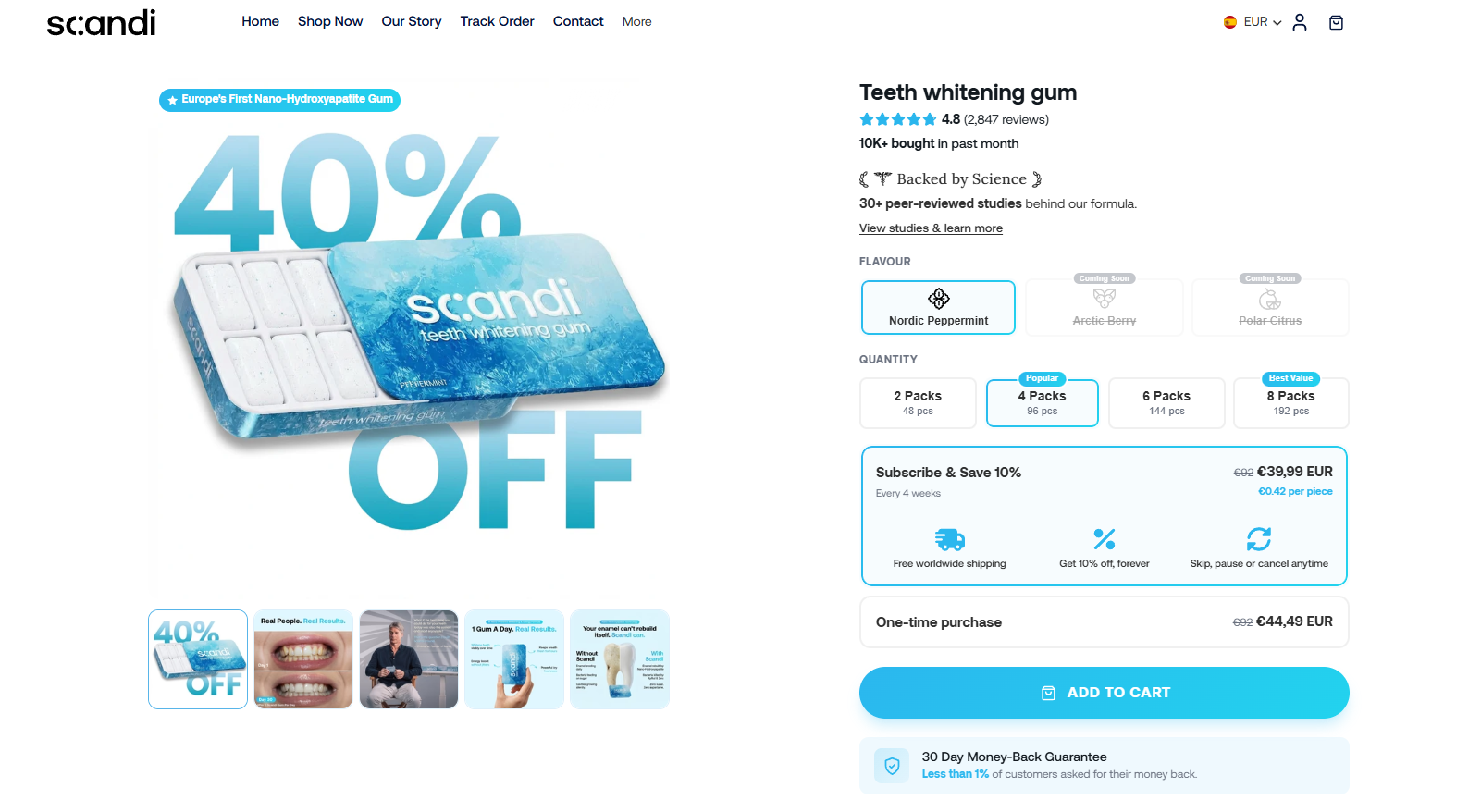
The formulation is sugar-free, enamel-conscious, and engineered for buccal absorption so you get faster onset and better bioavailability than a capsule or drink. If you want to understand the full scope of energy and dental benefits packed into a functional chew, that’s the place to start. Your jaw is already doing the work. Make sure the product you’re chewing is doing its part too.
Frequently asked questions
Does chewing gum actually give you more energy?
Chewing gum can temporarily increase energy expenditure and improve alertness, but the effects are mild and short-lived. Chewing raises diet-induced thermogenesis and influences insulin-related mechanisms, though functional chewing products with active ingredients amplify these baseline effects.
Can chewing improve cognitive performance?
Some studies show chewing boosts attention and vigilance, but the results are not universally consistent. Cognitive benefits from chewing depend heavily on task type, timing, and individual factors, with the strongest evidence supporting pre-task chewing for sustained attention work.
How is chewing used to deliver energy-boosting ingredients?
Chewing releases functional compounds directly into the buccal mucosa, bypassing liver metabolism for faster absorption. Research shows that chewing arugula extract increased NO and NO3 more effectively than swallowing the same dose in capsule form.
Does oral health affect the energy benefits of chewing?
Yes, oral health directly limits how much benefit you can extract from functional chewing. Malocclusion and tooth loss reduce brain blood flow triggered by chewing, which blunts both the cognitive and energetic outcomes that a healthy chewer would experience.